15 November 2010

“Honoring Our Nations Veteran’s: As Cancer Stricken Soldiers Go Ignored”


Sister Soldier: A Chronicle of Life After Iraq
By R. B. STUART
Post XXII


In the Vietnam war the U. S. Military sprayed the herbicide created by Dow Chemical, Agent Orange (also Purple, Green, Pink, White and Blue) for the improvement of road and waterway visibility and clearing camp perimeters of weeds. The military authorized its use assuring the deployed soldiers it was harmless. But reports circulated in 1964 of increased miscarriages, stillbirths and birth defects among exposed Vietnamese women and animals. In essence performing genocide on the East Asian population. By sabotaging the reproduction system of the would-be mothers---of future Red Soldiers. With 36 forms of Cancer associated to the “approved” chemical, and a 30-year incubation period---it would continue to do the U. S. Military’s handy work long after the end of the war.

Our use of carcinogenic chemicals and a cozyness with Big Pharma seems to fester during war time, as a more potent cocktail with severe adverse reactions is introduced with each war. In 1990 soldiers deployed for the Persian Gulf - Desert Storm war under Bush Senior's regime, the soldiers witnessed piles of dead animals in the desert. They were stacked into decomposing mounds five months prior to the troops arrival.

The animals weren't considered a direct threat since the soldiers weren't camped directly beside them. But the potential for breeding grounds of diseases remained. To contain the existing problem military personnel thoroughly sprayed the decaying animals with the insecticides; methyl carbamate and “Baygon” (a propxur produced by Bayer, the aspirin makers), “Sevin” (a carbaryl produced by Aventis, a French company and smallpox vaccine maker that donated close to $2 million to the Bush camp in 2000), and “Lannate” (a methomyl produced by the chemical making machine DuPont). All are listed as poisons. Our military has already chosen to die for their country---but does that include by the hand of Big Pharma too?

From their deployment, over the past twenty years Gulf War Veterans have faced an endless battle with the VA for their array of chronic health issues. Only to be pacified with an all-inclusive watered-down diagnosis of Gulf War Illness, and mediocre benefits for their exposure.

Our current Operation Iraqi Freedom [OIF] Veterans have since 2003, encountered a gamut of toxins in theatre; from the carcinogenic smoke of Burn Pits that includes feces from port-a-potty’s, to radiological exposure from inhalation or ingestion of depleted Uranium dust from spent munitions, both of which has infiltrated their camp environment, as well as the Iraqi civilians, via air, soil and water.

Without the DoD willingly coming forward with their cancer diagnoses amongst deployed soldiers, and refuting cancer as a war wound----medical doctors at the VA and other medical institutions are meeting challenges they’ve never seen before. As a percentage of soldiers are being diagnosed with rare, aggressive cancers post-deployment 4 – 36 months---that don’t fit the criteria of the illness.

Wyoming native, Cody Feeback [pictured above] joined the United States Marine Corps in 2002 at 18. The teen whose penchant for hunting, fishing, camping and spending time with his friends and family---would take second place to the Military service in which he became a devotee. “I loved the Marine Corps the friendships are like none other…it is a wonderful bond you experience with your fellow Marines,” explained SGT. Feeback whose home base from 2002 to 2005 was Camp Lejeune, N.C.

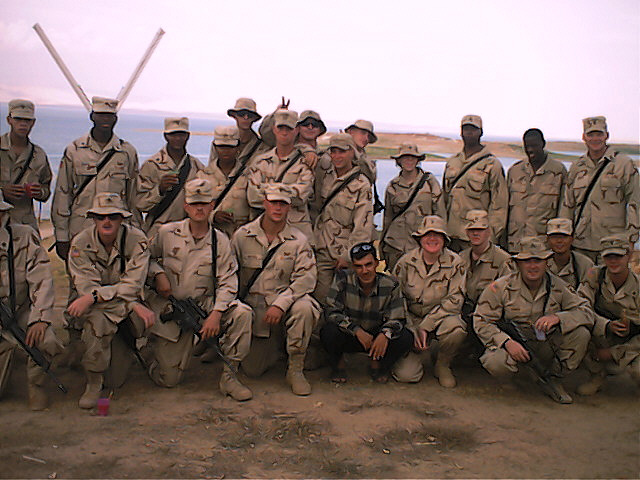
In February 2003 the 19 year-old deployed from Camp Lejeune in good health for his first tour in Kuwait, Iraq. He spent the next five months in northern Kuwait at Camp Coyote where as a Combat Engineer was in charge of Convoy Security. Like most soldiers, SGT. Feeback experienced vomiting and diarrhea in theatre, but like most soldiers deployed since 2003, was told it was normal. “I didn’t want my family to worry any more than they already were,” so SGT. Feeback never mentioned it. [on a night convoy below]


In the DoD’s own December 20, 2001 Field Manual, “Treatment of Nuclear and Radiological Causalities.” Chapter Three, page 13 outlines the radiological exposure dosages from 0 – 5 cGy being nominal and acceptable for military personnel during peacetime. But during war, if the dosages are from 75 – 300 cGy, onset in 6 hours the symptoms are headache and nausea at the low end of cGy, vomiting for the high range of cGy with an onset of 2 – 3 hours. The low range of duration is 12 hours upward to 3 – 4 days.

When diarrhea is included to the aforementioned symptoms, the cGy dosage ranges from 300 – 530. The onset of diarrhea within 2 – 6 hours with a duration of 2 – 3 weeks. There is a minimal 24-hour window after exposure to Uranium to order a urine or fecal bioassay. If ordered, those results are kept confidentially in the soldiers RER records [Radiation Exposure Records].

On Chapter Five, section I, Low Level Radiation, 5-2, B, Exposure Guidance page 5 – 1 and 5 – 2, “The risks associated with radiation exposure within the range of 5 – 75 cGy are confined primarily to the risk of increased incidence of malignant diseases, including solid tumors and leukemia.” So from their own admission, the U. S. Military is fully aware of radiation exposure of deployed troops resulting in a Cancer diagnoses, but maintain ignorance when a soldier is actually diagnosed post deployment.

SGT. Feeback’s tour ended July 2003 and returned to Camp Lejeune. He reconnected with his parents and three siblings, then in 2005 he transferred to Camp Pendleton, California. By that September he received orders to re-deploy. His second tour sent him to Fallujah, Iraq where over the next seven months he made a home at Camp Fallujah. Unaware that local doctors were recording high-rates of abnormal birth defects in Fallujah civilians.


Study Finds Iraq Littered with High Levels of Nuclear and Dioxin Contamination
The Guardian UK
--Jan. 22, 2010
• Greater rates of cancer and birth defects near
sites

• Depleted uranium among poisons revealed in report

More than 40 sites across Iraq are contaminated with high levels or radiation and dioxins, with three decades of war and neglect having left environmental ruin in large parts of the country, an official Iraqi study has found.

Areas in and near Iraq's largest towns and cities, including Najaf, Basra and Falluja, account for around 25% of the contaminated sites, which appear to coincide with communities that have seen increased rates of cancer and birth defects over the past five years. The joint study by the environment, health and science ministries found that scrap metal yards in and around Baghdad and Basra contain high levels of ionizing radiation, which is thought to be a legacy of depleted uranium used in munitions during the first Gulf war and since the 2003 invasion.

So when SGT. Feeback’s tour ended in March 2006 he returned to Camp Pendleton where he awaited the completion of his stint in the USMC. And by September 21, 2006 SGT. Feeback was honorably discharged. The only thing the 23 year-old had on his mind was living a comfortable and fun life with his family, so he moved back home to Wyoming. The next two years he worked as an equipment operator until a position opened at the local VA, in their warehouse shipping and receiving. Within a month he met Roxan, and 16 months later, in March 2010 they were engaged, and prepared for a September wedding.

Then without warning in July 2010 he developed Flu-like symptoms that sent him to the Sheridan VA Medical Center. “I complained of abdominal and lower back pain, the Doctor assumed it was appendicitis and ordered a urinalysis and CT scan,” the 27 year-old informed. “But when the Doctor read the CT scan they saw a mass on the right kidney.”

Immediately they medEvac him to the Denver VA for a biopsy. “The Doctors were certain after the biopsy it was Wilms Tumor, but were perplexed since it is a pediatric kidney cancer usually found in three to six year-old children.” The following day when the urine results came back he was diagnosed with Stage III.

“At first my response was disbelief and fear for my family,” he admitted. “I don’t have any idea if I was exposed to burn pits or had depleted Uranium exposure. Even so, I don’t blame anybody for this sickness…I just don’t like putting my family through all this stress.”

Within a month his right kidney was removed. “I underwent eleven rounds of radiation and am currently going through 24 weeks of chemotherapy,” SGT. Feeback informed. “I’ve had good care at the VA, and have had a lot of support with visitors and phone calls.” [Marine Feeback below]


On September 4, 2010, while undergoing treatments, SGT. Feeback married Roxan, and after serving 4 years and 8 months in the USMC he conveyed, “I was very proud to serve my country and I would do it again.”

The dedication a majority of soldiers have for the military is palpable. And no matter what they were exposed to during deployments, the selfless, courageous men and women serve with honor and devotion never blaming….even at their own peril. And if the U. S. Military subjugates the evidence of cancer stricken soldiers in attempts to hide the environmental genocide in Iraq….then its higher ranking officials will find themselves marred in the history books, as a disloyal superpower that thoughtlessly devoured its own.

In June 2010, Doug Rokke, Ph.D. retired, U.S. Army Major commented on the predicament Operation Iraqi Freedom [OIF] Veterans and civilians of war torn countries are subjected to. “We’ve ignored what we have done to the residents of the nations. We [the U.S. Military] has invaded without justification and then trashed their country. I have come to the realization that based on history we in the military bought the notion ‘to protect,’ but who are we protecting, and from whom?”

“We in the military are simply the extension of power and greed, reality not myth. And the abandonment of our Veteran’s is because of the casualty numbers, that we ourselves are responsible.”

“I am constantly bombarded by telephone, E-mail, knocks at my door, and stopped wherever I go. Every day more Veterans or their families seek help, and suffice to say it’s becoming worse---while we continue to set-up more of the same,” concluded the disabled Veteran Doug Rokke.


UN Health Agency, Iraq Studying Birth Defects

AFP Agence France-Presse
--Oct. 5, 2010


GENEVA (AFP) – The UN Health Agency, the World Health Organization (WHO) and Iraqi authorities are carrying out a survey of birth defects in Iraq following media reports of abnormal patterns in Fallujah, a WHO spokeswoman said.

“An investigation has begun in six governorates (administrative region) of Iraq into these reports of congenital defects,” WHO spokeswoman Fadela Chaib told journalists.

The BBC reported in March 2010 that large and growing numbers of birth defects were observed by doctors in Fallujah, a former insurgent stronghold west of Baghdad that was at the heart of some of the fiercest fighting with US forces.

Chaib said the scientific “pilot assessment” by “the Iraqi government with the help of the... WHO” began in July and would take about 18 months to complete.

The study covers Sulemaniah, Diyala, Baghdad, Dhi-Qar, Basra and Anbar province, which includes Fallujah.

It will lay out “the magnitude, distribution and trends of Congenital Birth Defects” in Iraq and establish a basis for comparison with today as well as between different parts of the country, according to the UN health agency.

Reports of health abnormalities among civilians in Iraq or soldiers who served there have sparked claims of links with special weaponry allegedly used during successive wars, including armour-busting depleted Uranium shells.

International Coalition To Ban Uranium Weapons, U.K.
--Oct. 29, 2010


The United Nations First Committee has voted, by an overwhelming margin, for state users of depleted Uranium weapons to release data on where the weapons have been used to governments of states affected by their use.

136 states voted in favor of a resolution calling on state users of depleted Uranium weapons to release quantitative and geographical data to the governments of affected states. The resolution will now go forward to the United Nations General Assembly for a second vote at the end of November 2010.

Although UN resolutions are non-binding, they are a useful means of focusing attention on key issues. In this case the ongoing failure of the US to release data on its use of depleted Uranium in Iraq and concerns over the use of the weapons in other conflicts, such as the interventions in Somalia in the mid-1990s.

The resolution was opposed by only four states - the US, UK, France and Israel. These four also voted against previous resolutions accepting that DU has the potential to damage human health (2007) and calling for more research in
affected states (2008).


CNN Audit: Military Using Potentially Harmful Methods of Burning Trash

By Adam Levine, CNN
--Oct. 15, 2010

Military bases in Iraq and Afghanistan continue to use waste methods that expose troops to potentially toxic emissions without fully understanding the effects, according to a new government audit obtained by CNN.


Between September 2009 and October 2010, investigators from the Government Accountability Office visited four bases in Iraq and reviewed planning documents on waste disposal for bases in Afghanistan. None of the Iraq bases visited were in compliance with military regulations. All four burned plastic--which generates harmful emissions--despite regulations against doing so.

The emissions have been the source of controversy as troops have complained about a host of problems, from cancerous tumors to respiratory issues, blaming exposure to burn pits. Military officials have denied any consequential effects on most troops.

Prior to an initial outcry about the pits more two years ago, the largest base in Iraq -- Balad Air Base -- was burning everything from hazardous and medical waste to plastics, using jet fuel as accelerant, according to military documents. The smoke poured over the living quarters and the base hospital, exposing thousands of troops to the emissions.

The U.S. military generates about 10 pounds of non-hazardous waste per service member each day and "may consist of plastic, Styrofoam, and food from dining facilities; discarded electronics; shipping materials such as wooden pallets and plastic wrap; appliances; and other items such as mattresses, clothing, tires, metal containers, and furniture," the report says.

According to the report, there were 221 burn pits in Afghanistan by August and more are anticipated. Only 21 remained in Iraq and, like the troop levels there, the numbers are expected to decrease. The burn pits are operated by either the military or contractors.

While the pits have been in use since the beginning of each war, regulations and guidance were only issued in 2009 -- eight years into the Afghanistan conflict and six years after the start of the war in Iraq.

The military's attitude about the impact of the burn pits has shifted. When complaints initially arose in 2008 military officials denied there was any hazard to troops. Last year the Pentagon changed that position, declaring long-term effects for troops who had pre-existing conditions was foreseeable.

A GAO analysis of the data from the samples collected found matter named on the CENTCOM list of potentially harmful substances. Investigators found that the samples which exceeded the levels considered safe if exposed for a year mostly contained fine particles. Fine particles can embed in the lung tissue, and of particular concern is when there is prolonged exposure.

Sen. Russ Feingold, D-Wisconsin, who has been vocal in his concern about troops' exposure to burn pits, urged the Pentagon to restrict the use of the pits in Afghanistan. “I am deeply troubled to learn that the Defense Department has not taken simple steps, such as segregating plastics, to ensure that our troops are not exposed to harmful emissions,” Feingold said in a statement.

The acting commander of Central Command, Lt. Gen. John Allen, wrote a letter to Feingold in July saying the military is trying to eliminate the use of burn pits at bases that are active for 90 days or more and occupied by 100 personnel or more. In Iraq, Allen anticipates there will be no burn pits by December of this year. Afghanistan is more challenging, but the military is in the process of procuring “almost 200 incinerators,” he said in the letter, obtained by CNN.


Labels: , , , , , , , , , , , , , , , ,

10 February 2007

"A DU MINEFIELD KNOWN AS IRAQ"


Sister Soldier: A Chronicle of Life After Iraq
By R. B. STUART
Part VI


Since the war in Iraq began soldiers effected by Depleted Uranium toxicity have undergone a media blackout. While the U. S. Media and DoD jointly turn a blind eye to the truth about what soldiers are being exposed to in Iraq, and the longer the public is ignorant to the goings on....then the DoD can continue bleeding the war chest, and the caskets will continue to be draped in an invisible cloth.

Shamefully, the U. S. mainstream media has held the dirty hands of the Washington power players who are making a bundle off the manufacturing of DU at the expense of our military men and women. Our soldiers will continue to be seen as disposable by those that govern, until mainstream media shakes the dust off the democracy, and freedom of truth---that they conveniently tucked away long ago. We must fight for our lives....for no one is looking out for us anymore.

### RBS


Below, a recent CNN Depleted Uranium media breakthrough for soldiers, following that is a new DU Bill and a copy of the 2007 Draft Bill now in congress.

CNN - AMERICAN MORNING Show Transcripts on Depleted Uranium Effecting the Troops in Iraq - February 5th & 6th 2007

CNN VIDEO LINKS of show:
[Part 1 - Feb. 5] http://rss.cnn.com/~r/rss/cnn_freevideo/~3/86824503/index.html
[Part 2 - Feb. 6] (not available in cnn.com) http://smartvideochannel.com/search.aspx?q=depleted+uranium&v=search&t=video

PART ONE:
http://transcripts.cnn.com/TRANSCRIPTS/0702/05/ltm.02.html Read below

Here's one highly effective and also very highly controversial weapon in the U.S. military arsenal. It's called depleted uranium or DU and some veterans are now suing the Army over what they say are health risks from their exposure to DU. Greg Hunter joins us this morning. He's got a special AMERICAN MORNING investigation.

Good morning, Greg. GREG HUNTER, CNN CORRESPONDENT: Good morning. Depleted uranium, the issue is exactly what U.S. soldiers may or may not know about its potential health impact. (BEGIN VIDEOTAPE)

HUNTER (voice-over): It's the U.S. military's most potent anti-tank weapon. Depleted uranium or DU, on impact, it burns through armor like a hot knife through butter, creating a plume of radioactive dust. Specialist Gerard Matthew cleaned up vehicles hit by DU during his five months in Iraq in 2003. He says breathing in depleted uranium dust made him sick.

GERARD MATTHEW, IRAQ WAR VETERAN: I came back with chronic migraines, swelling in my face and vision problems. HUNTER: Matthew also says his 2 1/2-year-old daughter's birth defect is a direct result of his DU exposure. He and seven other vets are suing the army over depleted uranium. The U.S. army insists its own testing of Iraq veterans shows no direct link between DU and illness or birth defects in humans.

COL. MARK MELANSON, WALTER REED ARMY MEDICAL CENTER: The radioactivity from depleted uranium is localized within the site of impact and it's not posed a significant immediate health hazard.

HUNTER: The World Health Organization and the Institute of Medicine seem to agree. They found no direct evidence linking DU to birth defects or cancer in humans, but a Pentagon sponsored study by the armed forces radio biology institute showed the combined effect of DU's heavy metal and its radioactivity can damage DNA and may cause genetic defects and tumors in animals and human stem cells. The military has warned about the potential dangers of breathing in DU contaminated dust, like in this instructional video produced for the U.S. military in 1995.

UNIDENTIFIED MALE: Heavy metal poisoning may occur, which can cause damage to internal organs and tissue.

HUNTER: That same video talks about radioactive particles that could be trapped in the lungs and possible water and soil contamination. The army's leading expert on DU hazard awareness training concedes these are all possibilities, but U.S. troops going over to Iraq never saw this tape.

MELANSON: There were lots of errors and conflicting messages in that training video, so it was not finalized and distributed to the troops.

HUNTER: Instead, the army's official training video, used since 2000, describes DU contamination this way.

UNIDENTIFIED MALE: These emissions are well below U.S. safety standards and do not pose a hazard to soldiers working with or around DU munitions.

HUNTER: The new video does tell soldiers to wear gloves and masks, especially inside DU-damaged vehicles or within 50 meters of fires that may involve DU. The problem is some soldiers like Gerard Matthew, say they never saw it. Dr. Asaf Durakovic studied the effects of DU on veterans of the first Gulf war for the U.S. military. He was alarmed by his findings. Now a private researcher, he also tested recent Gulf war vets, including Gerard Matthew whom Durakovic says has dangerously high levels of DU in his body.

DR. ASAF DURAKOVIC, URANIUM MEDICAL RESEARCH CTR: Inhalation of uranium dust is harmful.

HUNTER: Even in small amounts?

DURAKOVIC: Even in the amount of one atom.

HUNTER: Durakovic says those small atoms emit radiation for the rest of a soldier's life. Can't that hurt a soldier in the long run?

DR. MICHAEL KIRKPATRICK, DOD HEALTH AFFAIRS: It would come then to the dose, the total dose in their body and those particles are very, very small.

HUNTER: Matthew's wife wishes her husband had known more about the potential dangers of DU.

UNIDENTIFIED FEMALE: He wasn't told it's out there. He exposed my daughter to this, but it's not his fault. He was just trying to help the country.

(END VIDEOTAPE) HUNTER: Defense Department officials say the U.S. military used 320 tons of depleted uranium during the first Gulf war, but they were unable to tell us how much DU they have used in the current Gulf war, despite our repeated request for that information Published reports suggest the military has used between 1,100 and 2,200 tons. That's up to six times the amount of DU in Iraqi freedom than in the first Gulf war.

S. O'BRIEN: So they're testing all these soldiers to see if they're emitting radioactivity?

HUNTER: The government is. The Pentagon is, but there are some states out there passing laws to test their own National Guard troops because they say the test the government is using is not sensitive enough. We'll find out about that tomorrow in part two.

S. O'BRIEN: All right, part two, Greg Hunter, thank you. Miles


PART TWO:
http://transcripts.cnn.com/TRANSCRIPTS/0702/06/ltm.02.html Read below

O'BRIEN: Well, now to our AMERICAN MORNING special investigation on the fallout, if you will, from the use of depleted uranium in the war zone. It can cut through a foot of enemy armor and leave behind radioactive dust that some say is making vets sick. AMERICAN MORNING's Greg Hunter joining us now with part two of the series. Good morning, Greg.

GREG HUNTER, CNN CORRESPONDENT: Good morning, Miles.Depleted uranium, the controversial weapon and the radioactive dust it creates are at the center of a debate that just won't go away.

(BEGIN VIDEOTAPE) HUNTER (voice-over): Samala (ph), Iraq, spring 2003, Iraq, site of a fierce coalition offensive. Soldiers operating, sleeping, eating in areas that were hit by depleted uranium, or D.U. For some soldiers it marked the beginning of another type of battle. These five National Guard veterans claim they got sick from serving there.

RAYMOND RAMOS, IRAQ WAR VETERAN: I just got to the point where I could not physically stand sometimes. The headaches were unbearable. I would get dizzy spells.

HUNTER: They report similar ailments: painful urination, headaches and joint pain. They say Army doctors blame their: They report similar ailments symptoms on posttraumatic stress. We showed them a tape the Army made in 1995, a tape the Army never distributed. It warned of potential D.U. hazards. The Army's expert on D.U. training concedes some information contained on the tape is true. For instance, inhaling radioactive particles can be harmful. Video here: http://video.google.com/videoplay?docid=-7863767976205447371

UNIDENTIFIED MALE: Alpha is the least penetrating but is the most hazardous if it does get into the body.

HUNTER (on camera): So you're saying in part this is correct, but too much information?

UNIDENTIFIED MALE: It really doesn't provide any useful information to the soldier.

HUNTER (voice-over): These vets say they were never warned about D.U. They're suing the Army for what they say is knowingly exposing them to D.U. dust and failing to properly treat them.

ANTHONY YONNONE, IRAQ WAR VETERAN: They didn't furnish us with any of that information.

HUNTER (on camera): At all?

YONNONE: At all.

HUNTER: Does it make you angry?

YONNONE: Absolutely.

HUNTER: Why?

YONNONE: Because here we are sick. We don't know why. The Army don't know why, and they're just calling us liars.

HUNTER (voice-over): The veterans' claims against the government may be barred by a statute that protects the military from lawsuits by soldiers. But a judge is permitting the soldiers' claims of malpractice to go forward.

DR. ASAF DURAKOVIC, URANIUM MEDICAL RESEARCH CENTER: I personally call it not so depleted uranium.

HUNTER: In the 1990s Dr. Asaf Durakovic studied D.U. health effects for the U.S. military. Now a private researcher, Durakovic says his own test of these veterans showed abnormally high levels of D.U. in their urine and that those levels pose a serious health threat.

DURAKOVIC: There is genetic change in chromosoma of the regions (ph) in the people who have been found positive with depleted uranium.

HUNTER: The military's overall health expert says tests on thousands of veterans from both Iraq wars have produced very few positive D.U. tests.

DR. MICHAEL KIRKPATRICK, DEFENSE DEPARTMENT HEALTH AFFAIRS: We are not seeing it in 74 individuals who are most heavily exposed, and that, I think, is really the golden standard if you take a look at people who had heavy exposure, internalization, some still having the depleted uranium in their bodies, still excreting very high levels in their urine, and their health appears at this point to be normal.

HUNTER: Some scientists and politicians claim the Army's testing is not sophisticated enough. Connecticut state representative Pat Dillon helped pass legislation allowing her state to do its own testing of National Guardsmen.

PAT DILLON, CONNECTICUT STATE REPRESENTATIVE: It's a heavy metal. It gets absorbed into your bones. So I don't think that the test that they're using is sensitive enough to find whether or not you've been contaminated.

HUNTER: The Army tells CNN its policy is to get every soldier training in depleted uranium and hazard protection. It also has an updated instructional video, produced in 2000. We asked why these soldiers say not only did they not see the video, but they knew nothing about D.U. before going to Iraq.

COL. MARK MELANSON, WALTER REED ARMY MEDICAL CENTER: I'm not able to give you any statistics on who received training and who didn't receive training. I can just talk about the training that was provided and what the policy is.

(END VIDEOTAPE) HUNTER: Dr. Durakovic says one thing is for sure: a large part of Iraq is contaminated, particularly in the south where heavy tank battle took place. He calls it, quote, "a radiological sewer." The Army adamantly denies that.

O'BRIEN: When you go back and look at another war and another toxic agent, in that case Agent Orange in Vietnam. Veterans there had similar claims. Were sick because we were in contact with this Agent Orange. Ultimately, did they get claims from the military, and is that likely what's going to happen here?

HUNTER: Some did, but it took decades. And let me tell you, Agent Orange is tame compared to radiological dust that you can breathe into your lungs, stays in your body forever, has a half life of 4.5 billion years. This stuff stays around forever. So it is -- it is quite a controversy.

O'BRIEN: Keep us posted, Greg. Greg Hunter, thank you very much. In just a little while, Sanjay Gupta will join us, and he'll explain a little bit more about the medical implications of contact to this depleted uranium -- Alina.

Sanjay, good morning. So first things first, what are the symptoms of D.U. poisoning?

DR. SANJAY GUPTA, CNN CORRESPONDENT: There's sort of short-term symptoms and longer-term symptoms, and, you know, this is a difficult thing. The jury is still out among many researchers in terms of what's causing when and at what time. But if you look at some of the early things, you can get things like nausea and vomiting as your G.I. tract sort of reacts to the depleted uranium. Also, kidney problems potentially and skin lesions. There have been some case reports that it could possibly cause irritability and behavioral changes, as well, but that's not really nailed down. Longer term, it can get a little bit more complicated. You might develop things like an immune system damage. So you could actually suppress your white blood cells, those sort of -- those fighting cells of infection. Lung cancer potentially as well, although, again, it's somewhat controversial studies. And potentially birth defects in the offspring of people who were exposed to depleted uranium, as well. Alina, I should say -- I think as Greg pointed out as well, the depleted uranium and its potential link to Gulf War syndrome is one of the most controversial things probably that exists in medicine. A lot of people sort of focused on it. Probably not enough studies as of yet, still.

CHO: All right. So what about treatment? Is there any treatment for this?

GUPTA: Well, not really. I mean, first of all, it's very hard to know, for example, if someone has actually been exposed. You can test it in the blood. You can actually get some blood tests that will tell if you have higher levels of the particular isotope associated with depleted uranium, but for the most part you've got to let the thing sort of run out its course. It can cause damage to cells, and if those cells actually turn into tumor cells, for example, you obviously have to treat the cancer or remove the tumor, but it's hard to treat symptoms of depleted uranium poisoning overall.

CHO: All right. Dr. Sanjay Gupta, live for us in Atlanta. Sanjay, thank you.

GUPTA: Thank you.

###

DU BILL

110th CONGRESS 1st Session H. R. 207

To provide for identification of members of the Armed Forces exposed during military service to depleted uranium , to provide for health testing of such members, and for other purposes.

IN THE HOUSE OF REPRESENTATIVES
January 4, 2007

Mr. SERRANO introduced the following bill; which was referred to the Committee on Armed Services.
A BILL

To provide for identification of members of the Armed Forces exposed during military service to depleted uranium , to provide for health testing of such members, and for other purposes.
Be it enacted by the Senate and House of Representatives of the United States of America in Congress assembled,

SECTION 1. SHORT TITLE.
This Act may be cited as the `Depleted Uranium Screening and Testing Act'.

SEC. 2. DEPLETED URANIUM RISK NOTIFICATION FOR DEPLOYING FORCES.
(a) Notification- The Secretary of Defense shall establish procedures to require, as part of the procedures for preparing members of the Armed Forces for deployment to a theater of operations, that such members be notified of--
(1) any known or likely use of depleted uranium in that theater of operations (whether by forces of the United States and its allies or by any opposing forces); and
(2) any health risks associated with exposure to depleted uranium .
(b) Training- The Secretary shall provide for training deploying members of the Armed Forces on the safe handling of depleted uranium contamination before such members are deployed to a theater in which depleted uranium is used.

SEC. 3. DEPLETED URANIUM SCREENING AND TESTING.
(a) Identification and Testing Required- The Secretary of Defense shall carry out a program to identify individuals who, during active service in the Armed Forces, are or have been exposed to depleted uranium and to provide those individuals with bioassay testing and notification of the results of such testing.
(b) Depleted Uranium -Exposed Personnel Identification Methods-

(1) PROCEDURES FOR IDENTIFICATION OF EXPOSED MEMBERS- The Secretary of each military department shall establish procedures to identify members of the Armed Forces under the Secretary's jurisdiction who are, or may have been, exposed to depleted uranium . For such purpose, the Secretary shall identify units and members under paragraph (2) and shall accept self-identification reports by members under paragraph (3).

(2) IDENTIFICATION OF UNITS AND PERSONNEL- The Secretary of each military department shall identify units, and personnel assigned to units, that have been, or could have been, exposed to depleted uranium , based upon information about known exposure events (as determined under subsection (c)).

(3) SELF REPORTING- The Secretary of each military department shall accept a report by an individual, or a primary care provider for an individual, that the individual, while a member of the Armed Forces under the Secretary's jurisdiction, was, or may have been, exposed to depleted uranium based upon service on active duty (or training duty or funeral honors duty) in a theater of operations where depleted uranium was used, including travel through such an area. The Secretary shall prescribe procedures for receiving such reports. Such a self-identification report submitted to the Secretary under this paragraph shall be treated by the Secretary as identification of the individual for purposes of this subsection.

(4) TREATMENT OF INDIVIDUALS NO LONGER ON ACTIVE DUTY- In carrying out this subsection, the Secretary of each military department shall ensure that individuals no longer on active duty (including members of the reserve components who have been released from active duty, members who have been retired, and members who have been separated from service) are treated, for identification purposes, in the same manner as individuals remaining on active duty.

(c) Exposure Events-

(1) TYPES OF EVENTS- The Secretary of Defense shall identify depleted uranium exposure events for purposes of this section. The exposure events identified shall include the following:

(A) DIRECT EXPOSURES- An event in which an individual--
(i) is struck by depleted uranium munitions or depleted uranium armor fragments;
(ii) enters, or is present within 50 meters of, a vehicle or structure with possible depleted uranium residues; or
(iii) breathes smoke from fires involving depleted uranium materials.

(B) EQUIPMENT HANDLING EXPOSURES- An event in which an individual may inhale depleted uranium compound particulates as a result of the handling of equipment or wreckage that has been, or could have been, contaminated with depleted uranium .

(C) OTHER EXPOSURES- Other significant or incidental exposure events identified by the Secretary, including the performance of activities in the area of depleted uranium damaged vehicles or structures or the traveling through or residing in any such area.

(2) LIMITED RETROACTIVITY- In addition to exposure events described in paragraph (1) occurring on or after the date of the enactment of this Act, such events during the period between January 1, 2003, and the date of the enactment of this Act may be considered for purposes of this section, if reported during the 60-day period beginning on the date of the enactment of this Act.

(d) Health-Care Services Required-

(1) BIOASSAY PROCEDURE- Any individual identified under subsection (b) shall be provided a health screening test by the Secretary of Defense. Such test shall be carried out using a bioassay procedure developed by the Secretary of Defense in consultation with the Centers for Disease Control and Prevention. The same bioassay procedure shall be used for all individuals identified under subsection (b) and for all types of exposure or possible exposure identified under subsection (c).

(2) TIME FOR TEST-

(A) EXPOSURES AFTER ENACTMENT- In the case of an exposure event described in subsection (c) that occurs on or after the date of the enactment of this Act, the bioassay under paragraph (1) shall be administered not later than 180 days after the date of the event, except that in the case of an individual with an exposure event described in subsection (c)(3), the bioassay under paragraph (1) shall be administered not later than 30 days after the end of the individual's deployment in the theater of operations, but such individual may be provided the bioassay earlier upon the individual's request.

(B) EXPOSURES BEFORE ENACTMENT- In the case of an exposure event described in subsection (c) that occurs before the date of the enactment of this Act, the bioassay under paragraph (1) shall be administered not later than 180 days after the date of the reporting of the event under subsection (c)(2).

(3) FURNISHING OF RESULTS- The Secretary of Defense shall provide the results of any bioassay procedure under this subsection to the individual tested, and the primary care manager or primary care provider of that individual, not later than 30 days after the Secretary receives those results.

(e) Personnel Tracking- The Secretary of each military department shall establish procedures for collecting, tracking, and maintaining information on the health status of individuals tested under subsection (d) for the purpose of assessing any long-term health consequences of exposure to depleted uranium .

(f) Independent Review of Bioassay Types and Contamination Thresholds- The Director of the Centers for Disease Control and Prevention shall conduct an independent review of bioassay types and contamination thresholds for purposes of the testing under subsection (d).

(g) Treatment- Based on the results of the bioassay tests, the Secretary of the military department concerned shall provide appropriate treatment for any illness of an individual resulting from a depleted uranium contamination or exposure.

SEC. 4. COMPTROLLER GENERAL SURVEY AND REPORT ON RADIOISOTOPE IDENTIFICATION EQUIPMENT USED BY DEPARTMENT OF DEFENSE.

(a) Survey- The Comptroller General shall conduct a survey of radioisotope identification equipment used by the Department of Defense in order to assess the capability of Department of Defense facilities to identify concentrations of different radioisotopes in naturally occurring levels of uranium .

(b) Report- The Comptroller General shall submit to Congress a report on the results of the survey under subsection (a) not later than 180 days after the date of the enactment of this Act.
H.R.207 Title: To provide for identification of members of the Armed Forces exposed during military service to depleted uranium, to provide for health testing of such members, and for other purposes.

Sponsor: Rep Serrano, Jose E. [NY-16] (introduced 1/4/2007) Cosponsors (11) Latest Major Action: 2/1/2007 Referred to House subcommittee. Status: Referred to the Subcommittee on Military Personnel.

COSPONSORS (11), ALPHABETICAL
Rep Conyers, John, Jr. [MI-14] - 1/23/2007
Rep Crowley, Joseph [NY-7] - 1/23/2007
Rep Engel, Eliot L. [NY-17] - 1/30/2007
Rep Farr, Sam [CA-17] - 1/23/2007
Rep Grijalva, Raul M. [AZ-7] - 1/30/2007
Rep Hinchey, Maurice D. [NY-22] - 1/30/2007
Rep Lewis, John [GA-5] - 1/24/2007
Rep Markey, Edward J. [MA-7] - 1/30/2007
Rep McCarthy, Carolyn [NY-4] - 1/24/2007
Rep McDermott, Jim [WA-7] - 1/23/2007
Rep Wexler, Robert [FL-19] - 1/31/2007

###

DRAFT BILL NOW IN CONGRESS

110th U.S. Congress (2007-2008) H.R. 393:
Draft Reinstate bill HR 393 IH 110th CONGRESS 1st Session H. R. 393

To require all persons in the United States between the ages of 18 and 42 to perform national service, either as a member of the uniformed services or in civilian service in furtherance of the national defense and homeland security, to authorize the induction of persons in the uniformed services during wartime to meet end-strength requirements of the uniformed services, to amend the Internal Revenue Code of 1986 to make permanent the favorable treatment afforded combat pay under the earned income tax credit, and for other purposes.

IN THE HOUSE OF REPRESENTATIVES
January 10, 2007, Mr. RANGEL introduced this bill; which was referred to the Committee on Armed Services, and in addition to the Committee on Ways and Means, for a period to be subsequently determined by the Speaker, in each case for consideration of such provisions as fall within the jurisdiction of the committee concerned.

Labels: , , , , , , , , ,